TrackFarm’s DayFarm platform is not merely a collection of smart devices; it is a meticulously engineered, three-pronged system designed to achieve end-to-end automation and optimization in livestock farming. The platform is structured around three core pillars: Software (SW), Internet of Things (IoT), and ColdChain logistics, creating a seamless data flow from the pigpen to the consumer.
2.1. DayFarm Software (SW): The Intelligence Core and Data Pipeline
The software component serves as the central nervous system of the entire operation. It is responsible for ingesting massive streams of data from the IoT layer, processing it through proprietary deep learning models, and presenting actionable insights to farm managers. The sheer volume and velocity of the data—continuous video feeds, thermal scans, and environmental readings—necessitate a robust, high-throughput data pipeline.
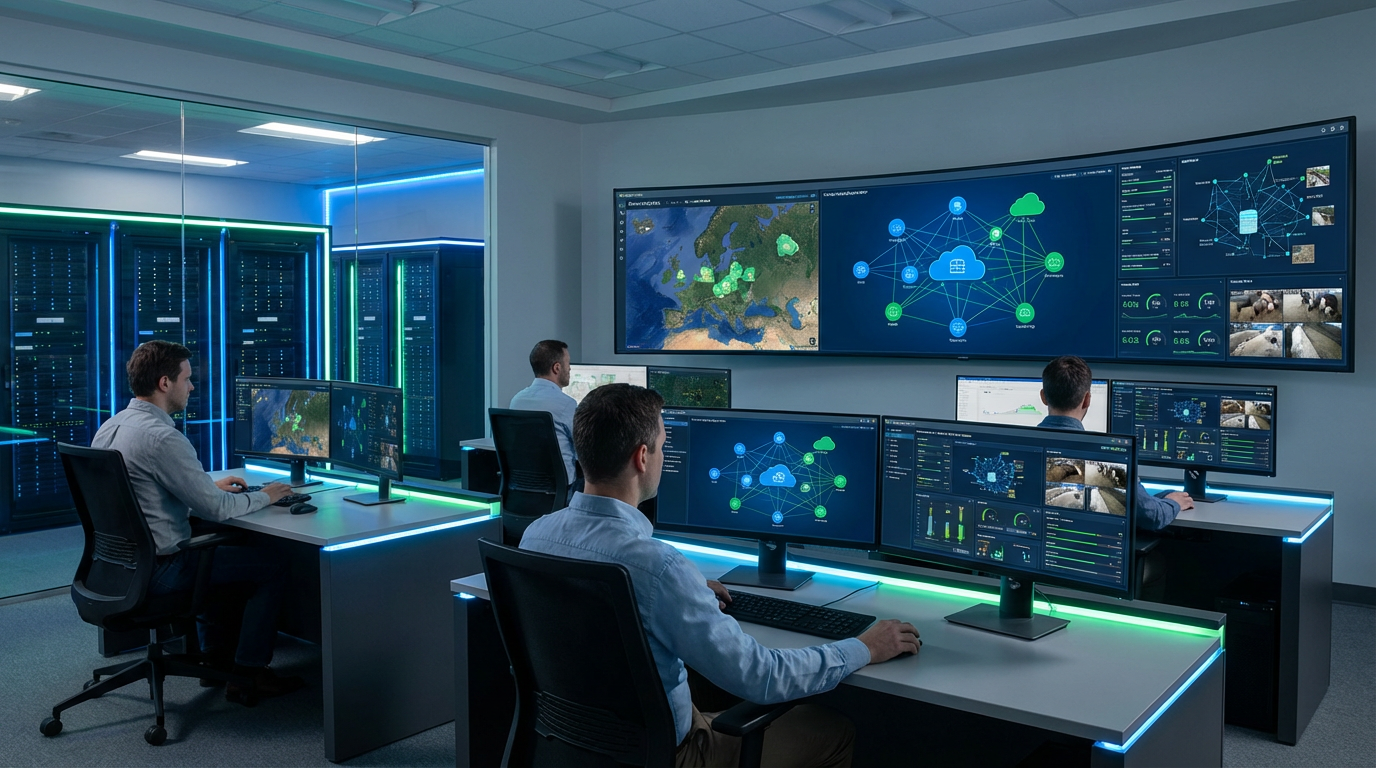
The architecture is built on a hybrid cloud/edge model, a technical necessity for real-time agricultural applications. Edge computing devices, often integrated with the AI cameras and sensors, perform initial data filtering, feature extraction, and real-time inference to minimize latency for critical tasks. For instance, immediate detection of a pig exhibiting signs of distress or a sudden spike in ammonia levels must trigger an alert within milliseconds. This is achieved by deploying lightweight, optimized versions of the deep learning models directly onto the edge hardware, likely utilizing specialized hardware accelerators like NVIDIA Jetson or similar NPUs (Neural Processing Units) for efficient on-device processing.
The processed, compressed data is then transmitted to a central cloud platform for long-term storage, complex analysis, and model retraining. This cloud infrastructure, likely leveraging a scalable solution like AWS or Google Cloud, manages a data lake containing the 7,850+ individual pig model data. The data pipeline involves several stages:
- Ingestion: Using message queues (e.g., Kafka or Kinesis) to handle the high-velocity stream of time-series and event data.
- Processing: Utilizing distributed computing frameworks (e.g., Spark) for cleaning, transformation, and aggregation of multi-modal data.
- Storage: Employing a combination of NoSQL databases for fast access to real-time metrics and object storage (e.g., S3) for the massive archive of raw video and thermal data used for model refinement.
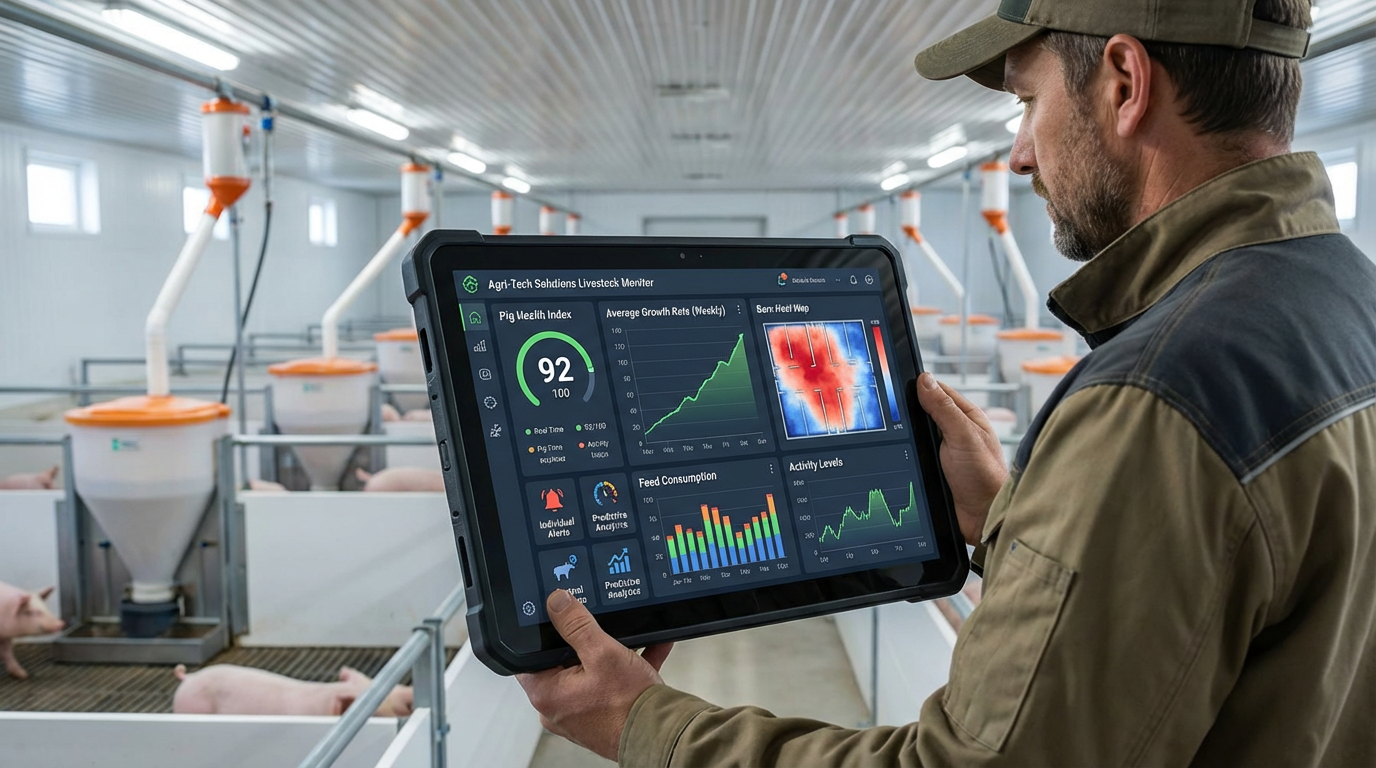
The user interface, accessible via web and mobile applications, provides a comprehensive Digital Twin of the farm environment. This is not a static 3D model but a dynamic, data-driven visualization that updates in real-time. Key features include:
- Real-time Environmental Monitoring: Display of temperature, humidity, air quality (NH3, H2S), and ventilation status, often visualized using dynamic heatmaps and time-series charts.
- Individual Animal Tracking: Visualization of pig location, activity levels, and growth trajectory, allowing a farm manager to click on any individual pig for its complete health and growth history.
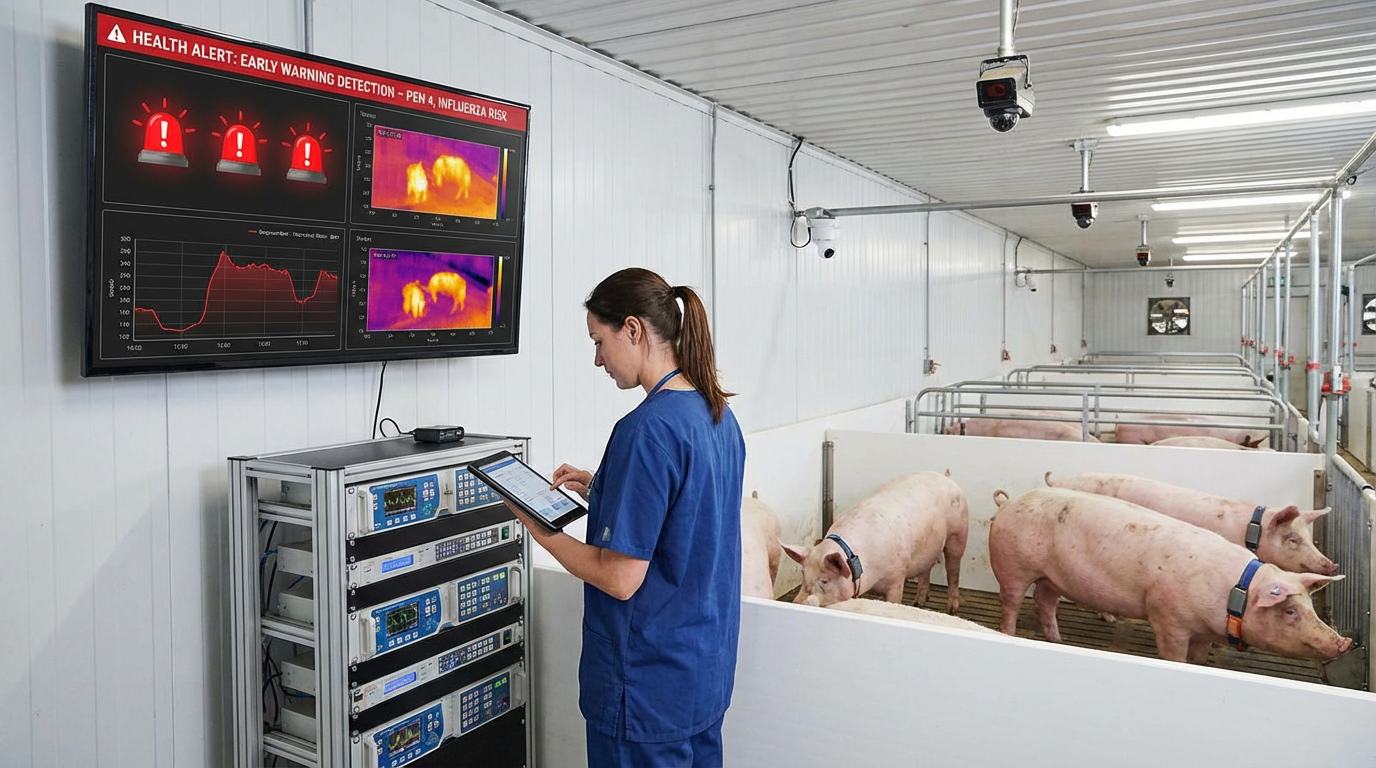
- Predictive Analytics Dashboard: Critical alerts for potential disease outbreaks, growth anomalies, and equipment malfunctions, prioritized by severity and predicted impact. The alert mechanism is technically sophisticated, employing statistical process control and machine learning anomaly detection on the aggregated data streams.
The system’s ability to synthesize data from multiple sources—visual, thermal, and environmental—into a single, coherent dashboard is a critical technical differentiator, moving farm management from reactive observation to proactive, data-driven intervention.
2.2. IoT Infrastructure: The Data Acquisition Layer and Environmental Resilience
The IoT layer is the physical backbone of DayFarm, responsible for the high-fidelity collection of farm data. The design emphasizes robustness, low power consumption, and scalability across diverse farm layouts, from the R&D facility in Hoengseong, Korea, to the large-scale operations in Dong Nai, Vietnam. The choice of hardware and communication protocols is dictated by the challenging environment of a livestock farm.
Key Technical Specifications of the IoT System:
| Component | Specification | Function | Technical Consideration |
|---|---|---|---|
| AI Camera System | 1 camera per 132㎡, High-resolution IP67 rated | Continuous visual monitoring, behavior analysis, and growth estimation. | Corrosion Resistance: Housing must withstand high ammonia and humidity levels. |
| Thermal Imaging Sensors | High-resolution, non-contact, calibrated for emissivity | Early detection of fever, inflammation, and stress-related conditions. | Calibration: Requires continuous recalibration to account for ambient temperature fluctuations. |
| Environmental Sensors | Electrochemical (NH3, H2S), Capacitive (Temp/Humidity) | Automated climate control and air quality management. | Sensor Drift: Requires self-calibration or periodic manual calibration due to chemical exposure. |
| Data Transmission | LoRaWAN, Wi-Fi, or 4G/5G | Reliable, low-latency data backhaul to the edge/cloud. | Protocol Selection: LoRaWAN for low-power, long-range environmental data; 4G/5G for high-bandwidth video streams. |
| Edge Processing Unit | Embedded GPU/NPU, Fanless Design | Real-time object detection, tracking, and data compression. | Heat Dissipation: Fanless design is crucial to prevent dust and moisture ingress. |
The AI camera deployment density (1 per 132㎡) is a deliberate design choice, ensuring that the deep learning models have sufficient visual context to track individual pigs, even in densely populated pens. This level of granularity is essential for the system’s core function: moving from herd-level management to individualized livestock care. The system’s reliance on non-contact sensing (visual and thermal) minimizes stress on the animals and eliminates the need for invasive tracking tags, which can be prone to failure.
2.3. ColdChain Integration: The Vision of End-to-End Optimization
The DayFarm platform extends its influence beyond the farm gate through its ColdChain component. While the primary focus is on farm automation, the system is designed to integrate with logistics and processing partners, embodying TrackFarm’s vision: “From Production To Consumption.” This integration is a strategic move to capture value across the entire supply chain and provide a level of product traceability that is increasingly demanded by consumers and regulators.
Technically, this involves:
- Quality Data Transfer via API: Providing verifiable, real-time data on the animal’s health, growth history, and environmental conditions to the processing facility via secure API endpoints. This data is used to optimize slaughter timing and carcass quality prediction, ensuring a consistent, high-quality output.
- Logistics Optimization: Using the predicted harvest dates and volumes from the SW platform to schedule and optimize cold chain logistics. This predictive scheduling minimizes idle time, reduces energy consumption in storage, and ensures the shortest possible time-to-market, which is critical for maintaining meat quality.
- Blockchain Integration (Hypothetical): While not explicitly stated, the “Production To Consumption” vision strongly suggests a future integration with blockchain technology to create an immutable record of the animal’s life cycle, from birth to processing, enhancing consumer trust and combating food fraud.
This integration transforms the farm from an isolated production unit into a transparent, data-driven node in the larger food supply chain, creating a closed-loop system that maximizes efficiency and quality control.
III. Deep Dive into AI and Deep Learning Technology
The core innovation of DayFarm lies in its sophisticated application of deep learning to the complex, dynamic environment of a pig farm. The system leverages a massive, proprietary dataset to achieve a level of monitoring precision previously unattainable.
3.1. The Deep Learning Model: Pig-Specific Intelligence and Architecture
TrackFarm has amassed a dataset of 7,850+ individual pig model data. This is not simply a collection of images, but a rich, multi-modal dataset that includes visual tracking, thermal signatures, weight estimations, and behavioral patterns correlated with health outcomes. The sheer size and diversity of this dataset—collected from both Korean and Vietnamese farm environments—is a significant competitive moat.
The deep learning models are a complex ensemble designed for multi-task learning:
- Object Detection and Tracking (ODT): The system likely employs a state-of-the-art, single-shot detector architecture, such as a highly optimized version of YOLO (You Only Look Once) or SSD (Single Shot MultiBox Detector). This is necessary for real-time performance on the edge devices. The ODT module identifies and assigns a unique ID to every pig in the frame, maintaining its identity across frames and camera views.
- Behavioral Classification: This module takes the tracked pig’s trajectory and posture data over a time window and classifies its activity (e.g., feeding, drinking, resting, fighting, isolation). This is typically handled by a Recurrent Neural Network (RNN) or a Transformer-based model that can analyze sequential data. The classification of “isolation” or “lethargy” is a primary indicator for early disease detection.
- Biometric Estimation: Non-contact estimation of weight and growth rate is a key technical challenge. This is achieved by using the camera system to perform 3D reconstruction of the pig’s body shape and volume. The model, likely a specialized Convolutional Neural Network (CNN), is trained to correlate these geometric features with actual weight measurements, providing a highly accurate, non-invasive alternative to manual weighing.
The model’s ability to process this multi-modal data stream enables the system to detect subtle deviations from normal behavior, often days before a human observer or traditional veterinary methods could identify a problem. This predictive capability is the engine behind the 99% labor cost reduction.
3.2. Key Technical Specifications and Performance Metrics
The AI capabilities translate directly into tangible operational benefits, which can be quantified through performance metrics:
| Capability | Technical Mechanism | Operational Benefit | Performance Metric (Hypothetical) |
|---|---|---|---|
| Growth Prediction | Time-series analysis of biometric data and feeding patterns | Optimized feed conversion ratio (FCR) and precise harvest scheduling. | Weight Estimation Accuracy: ±2% of actual weight. |
| Disease Prevention | Thermal imaging anomaly detection and behavioral change analysis | Early intervention, reduced mortality, and minimized spread of infection. | Disease Detection Latency: < 12 hours from onset of behavioral change. |
| Labor Automation | Automated environmental control and AI-driven alerts | 99% reduction in manual labor costs for monitoring and routine tasks. | Alert Precision: > 95% True Positive Rate for critical events. |
| Individualized Care | Unique ID tracking for 7,850+ models | Tailored management strategies for specific animals. | Tracking Accuracy (ID Switch Rate): < 0.1% per day. |
The 99% labor cost reduction is a powerful metric, indicating that the system handles virtually all continuous monitoring and environmental regulation autonomously, freeing up farm staff for high-value tasks like veterinary care and maintenance. The precision of the weight estimation is particularly valuable, allowing farmers to optimize feed consumption and ensure animals are harvested at their peak market weight, maximizing profitability.
IV. Market Dynamics and Global Expansion Strategy
TrackFarm’s technology is positioned to capitalize on a massive, yet technologically underserved, global market. The company’s strategic focus on both the developed Korean market and the rapidly expanding Vietnamese market provides a robust blueprint for international scaling.
4.1. The Vietnamese Market: A Strategic Beachhead and Economic Impact
Vietnam represents a critical strategic target for DayFarm, offering both immense scale and a pressing need for modernization. The country’s swine industry is characterized by a high volume of production but a fragmented structure, making it ripe for technological disruption.
Vietnam Pig Market Analysis:
| Metric | Data Point | Implication for DayFarm | Economic Impact Potential |
|---|---|---|---|
| Global Ranking | 3rd largest pig market globally | High volume, significant potential for large-scale deployment. | Stabilizing domestic meat supply and reducing import reliance. |
| Total Pig Population | 28 Million+ pigs | Vast addressable market for the $300/pig/year revenue model. | $8.4 Billion annual addressable market (at full penetration). |
| Farm Structure | 20,000+ small farms | Opportunity for consolidation and modernization through accessible technology. | Increased efficiency and competitiveness for small-to-medium enterprises (SMEs). |
| Partnerships | CJ VINA AGRI, VETTECH, INTRACO | Established local distribution and operational support network. | Accelerated market entry and reduced regulatory friction. |
The structure of the Vietnamese market, dominated by numerous small farms, suggests that DayFarm’s solution must be both highly effective and cost-efficient to drive adoption. The partnership with major local players like CJ VINA AGRI is crucial for navigating the local regulatory and distribution landscape. TrackFarm’s operational presence in Ho Chi Minh and Dong Nai serves as a vital real-world testing and demonstration ground for Southeast Asian expansion, proving the platform’s adaptability to tropical climates and local farming practices.
4.2. Business Model and Value Proposition
TrackFarm employs a multi-faceted revenue model designed to capture value across the entire livestock lifecycle, ensuring a sustainable and high-margin business. The core value proposition is a significant Return on Investment (ROI) driven by efficiency gains and risk reduction.
TrackFarm Revenue Model Breakdown:
| Revenue Stream | Price Point | Value Proposition to Farmer | Financial Model Type |
|---|---|---|---|
| HW/SW Subscription | $300 per pig per year | Risk Reduction: Early disease detection reduces mortality; Efficiency: Automated monitoring and environmental control. | Annual Recurring Revenue (ARR) |
| Breeding Optimization | $330 per pig | Productivity: AI-guided breeding management increases litter size and quality. | Value-Added Service |
| Processing/Logistics | $100 per pig | Profit Maximization: Precise harvest timing and quality assurance via ColdChain data. | Transactional/Per-Head Fee |
This model shifts the relationship from a one-time sale to a continuous partnership, where TrackFarm’s success is directly tied to the farmer’s increased efficiency and profitability. The high annual recurring revenue (ARR) potential per animal makes the platform highly attractive to institutional investors and large-scale farm operators. The $300/pig/year subscription is justified by the estimated 99% labor cost reduction and the significant decrease in feed costs and mortality rates.
4.3. Global Expansion and Corporate Milestones
TrackFarm’s trajectory is marked by significant corporate and technological validation, positioning it for expansion into target markets including the USA and the broader Southeast Asian region.
- Founding and Leadership: Founded in December 2021 by CEO Yoon Chan-nyeong, the company has rapidly moved from R&D to commercial deployment, demonstrating agility and rapid execution.
- Validation: Selected for the prestigious TIPS program in 2023, a key indicator of technological innovation in Korea, providing crucial government backing and funding.
- Global Showcase: Participation in CES 2024 and 2025 demonstrates a commitment to global visibility and market entry, particularly targeting the technologically advanced US market.
- R&D Infrastructure: The R&D Farm in Hoengseong, Korea, with over 2,000 pigs, and the Vietnam Farm with over 3,000 pigs, provide continuous data streams for model refinement and platform stress testing in diverse climates. This dual-location R&D strategy is essential for building a truly global, climate-agnostic AI model.
- Academic Partnerships: Collaborations with Seoul National University and Korea University ensure a pipeline of cutting-edge research and talent, reinforcing the technical depth of the platform and its commitment to scientific rigor.
V. Technical Challenges and Future Outlook
While the DayFarm platform represents a significant advancement, its continued success hinges on addressing several technical and operational challenges inherent in large-scale AgTech deployment.
5.1. Data Heterogeneity and Model Generalization
The core technical challenge is ensuring the AI models generalize effectively across vastly different farm environments. Factors such as barn construction, lighting conditions, pig breeds, and local climate (e.g., the difference between Korea’s temperate climate and Vietnam’s tropical climate) introduce significant data heterogeneity.
TrackFarm’s solution is likely a strategy of federated learning or continuous model adaptation, where the core model is refined using local data from each partner farm (e.g., the 10+ farm partnerships). The 7,850+ pig model data must be constantly updated and diversified to maintain the high accuracy required for growth prediction and disease detection. The system must be robust enough to handle sensor drift and occasional data outages without compromising its predictive power. Furthermore, the models must be trained to be resilient to adversarial conditions, such as dust, fog, or sudden changes in lighting, which are common in farm environments.
5.2. Scalability and Maintenance of IoT Infrastructure
Deploying and maintaining a dense network of AI cameras and sensors (1 per 132㎡) across thousands of farms presents a logistical and technical hurdle. The system must be designed for:
- Remote Diagnostics: The ability to remotely monitor the health and performance of every sensor and edge device, including battery life, connectivity status, and sensor calibration. This requires a sophisticated Device Management Platform (DMP).
- Over-the-Air (OTA) Updates: Seamless deployment of software and firmware updates to the edge devices to introduce new features or patch vulnerabilities without requiring on-site technical staff.
- Environmental Resilience: Hardware must withstand the harsh, corrosive environment of a livestock farm (high humidity, ammonia exposure). This necessitates the use of industrial-grade, chemically resistant materials and sealed enclosures (e.g., IP67 or higher).
5.3. The Future of Autonomous Livestock Management
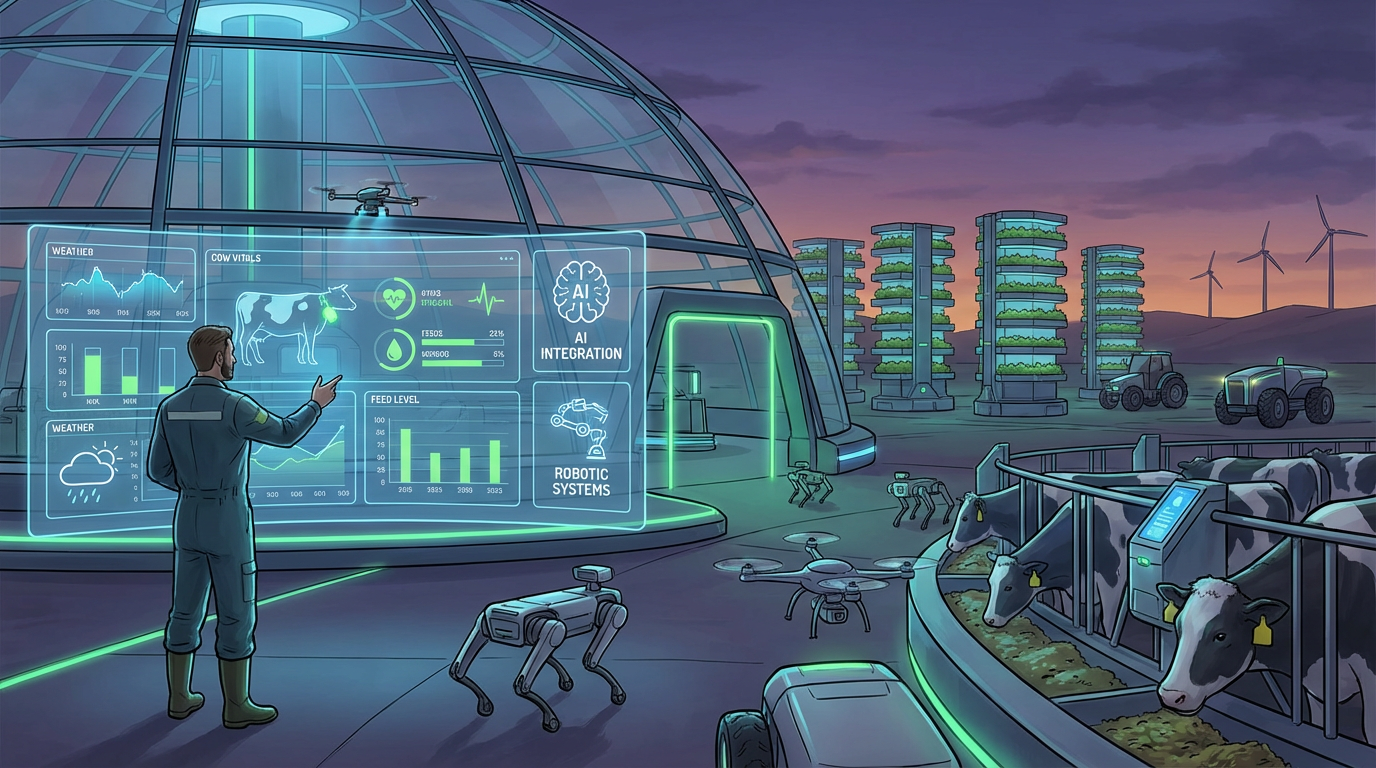
The DayFarm platform is a clear step toward fully autonomous livestock management. The current 99% labor reduction in monitoring suggests the next frontier is the automation of physical tasks, such as feeding, cleaning, and individual treatment delivery, all guided by the AI’s precise data.
The integration of DayFarm’s data with advanced robotics could lead to a system where:
- The AI identifies a pig requiring a specific treatment (e.g., a minor injury) with high confidence.
- A robotic system is dispatched to the exact location (using GPS/indoor localization and computer vision).
- The robot administers the treatment or separates the animal for human intervention, minimizing human contact and the spread of disease.
TrackFarm’s current foundation—deep learning models trained on vast, proprietary data, coupled with a robust IoT layer—positions it as a leader in this transition. The company is not just selling a product; it is selling a fundamental shift in the economics and sustainability of global pig farming. The platform’s success in diverse markets like Korea and Vietnam will serve as a critical case study for the future of AgTech worldwide.
The comprehensive, data-driven approach of DayFarm is set to redefine the industry standard, moving livestock farming from a labor-intensive, reactive process to a capital-efficient, predictive science. The journey from “Production To Consumption” is now paved with data.
VI. Comparative Technical Analysis: DayFarm vs. Traditional Systems
To fully appreciate the technical leap represented by DayFarm, a comparative analysis with traditional livestock management systems is essential. Traditional systems rely heavily on manual labor, periodic veterinary checks, and aggregated pen-level data.
6.1. Data Granularity and Frequency
| Feature | Traditional System | DayFarm Platform | Technical Advantage |
|---|---|---|---|
| Data Granularity | Pen-level (e.g., total feed consumption per pen) | Individual Pig-level (e.g., individual weight, activity, and thermal signature) | Enables individualized care and precise resource allocation. |
| Data Frequency | Daily (manual checks) or Weekly (manual weighing) | Continuous, Real-time (24/7 monitoring) | Drastically reduces latency in disease detection and intervention. |
| Disease Detection | Visual observation by staff, post-mortem analysis | Predictive AI-driven Anomaly Detection (behavioral/thermal changes) | Shifts from reactive treatment to proactive prevention. |
| Weight Estimation | Manual scale weighing (stressful, labor-intensive) | Non-contact 3D Biometric Estimation | Improves accuracy, reduces labor, and eliminates animal stress. |
6.2. Economic and Operational Efficiency
The technical superiority translates directly into profound economic benefits, which is the ultimate driver for adoption in the agricultural sector.
The stated 99% reduction in labor costs for monitoring is a direct result of replacing continuous human observation with the automated, AI-driven IoT system. This labor is not eliminated but reallocated from low-value, repetitive monitoring tasks to high-value, skilled tasks like veterinary care and strategic farm management.
Furthermore, the precision of the AI-driven growth prediction significantly improves the Feed Conversion Ratio (FCR). By ensuring each pig is harvested at its optimal weight and minimizing over-feeding, the system directly impacts the largest operational cost in pig farming: feed. A marginal improvement in FCR across a 3,000-pig farm translates into hundreds of thousands of dollars in annual savings.
6.3. Environmental and Sustainability Impact
DayFarm’s technology also addresses the growing global demand for sustainable and ethical farming practices. The precise environmental control, guided by real-time sensor data, allows for optimized ventilation and temperature regulation, reducing energy consumption. More importantly, the early detection of disease reduces the need for prophylactic antibiotics, contributing to the global effort to combat antimicrobial resistance (AMR). The system’s ability to isolate sick animals quickly is a technical mechanism for reducing the overall pathogen load in the farm environment.
VII. Conclusion: The Dawn of Autonomous AgTech
TrackFarm’s DayFarm platform is a paradigm shift in livestock management, moving the industry from an analog, labor-intensive model to a digital, data-driven, and autonomous one. The platform’s integrated architecture—combining robust IoT hardware, a high-throughput data pipeline, and proprietary deep learning models—provides a comprehensive solution to the industry’s most pressing challenges: labor costs, disease management, and supply chain transparency.
The company’s strategic focus on both the mature Korean market and the high-growth Vietnamese market demonstrates a clear path for global scalability. The technical specifications, particularly the 1 camera per 132㎡ density and the 7,850+ pig model data, underscore the depth of their commitment to precision agriculture.
As the global food supply chain faces increasing pressure from population growth and climate change, technologies like DayFarm are not just efficiency tools—they are essential components of future food security. The successful deployment and continuous refinement of this platform will serve as a critical blueprint for the next generation of AgTech, proving that the journey “From Production To Consumption” can be optimized, transparent, and driven by the power of artificial intelligence.